Fall Turkey Shotgun Season Basics
By J. B. Ellis, Kentucky

Most people picture turkey hunting as a spring thing: gobbling toms and early mornings. Kentucky has a fall season too, and it's a really good, low-pressure way to get a new hunter or a kid into the woods. Here's what KDFWR's official guide says, plus some beginner tips.
How fall turkey hunting differs from spring
In spring, hunters mostly call in gobblers during breeding season. In fall, the birds aren't breeding. They're traveling in flocks, often family groups of hens and young birds, focused on food. That changes your approach:
- It's about food and travel routes. KDFWR's Turkey Hunting page says fall hunting "emphasizes scouting flocks and hunting food sources." It suggests looking for mast-producing woods, listening for scratching in the leaves, and setting up on travel routes and feeding areas.
- Either sex can be legal within the bag limits below. Spring rules are different.
- Dogs are allowed. KDFWR says dogs may be used in the fall season to locate and flush turkeys.
- Calling is different. Many fall hunters use softer clucks, yelps and the "kee-kee" sounds of young birds trying to regroup. I'm still learning this part, and a local mentor or a hunter education program can teach it far better than an article can.
This year's dates and bag limits
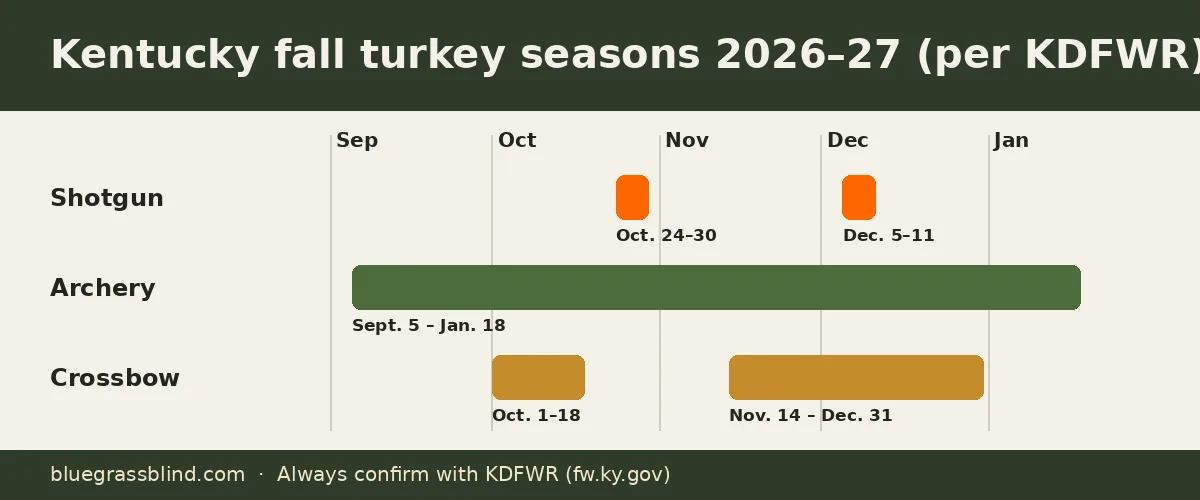
KDFWR's Fall Turkey Hunting page lists the 2026–27 fall seasons:
- Shotgun: Oct. 24–30 and Dec. 5–11, 2026
- Archery: Sept. 5, 2026 – Jan. 18, 2027
- Crossbow: Oct. 1–18 and Nov. 14 – Dec. 31, 2026
The regulation (301 KAR 2:144) sets the firearm season as seven days starting the fourth Saturday in October and seven days starting the first Saturday in December. Legal shooting hours are from one-half hour before sunrise to one-half hour after sunset.
Bag limit: KDFWR says licensed hunters can take up to two turkeys in the fall season, only one per day, even if they took two birds in spring. Of the two, only one may have a beard 3 inches or longer, and only one may have no beard or a beard under 3 inches.
A note on what's coming: the NWTF's 2026 fall guide reports that the Kentucky Fish and Wildlife Commission voted to restrict fall hen harvest by bow and crossbow (except for youth) starting with the 2027–28 season, but says that hadn't yet been approved by the legislature. I haven't confirmed that on fw.ky.gov, so treat it as pending and check KDFWR before next fall.
Licenses and permits
From KDFWR's fall turkey page: unless exempt, fall turkey hunters 16 and older must carry proof of a valid Kentucky annual hunting license and a fall turkey permit. The fall permit covers the archery, crossbow and shotgun fall seasons. KDFWR's guide notes both are included in the resident Sportsman's, Senior and Disabled licenses.
Important: 1-day and 7-day short-term hunting licenses are not valid for turkey hunting.
Youth have their own licensing, and hunter education rules apply. KDFWR's turkey guide says hunters 12–15 need a hunting license and turkey permit (a youth turkey permit or, for residents, a Youth Sportsman's License), while kids under 12 don't, and children under 16 must be accompanied by an adult in position to take immediate control of the firearm. Hunter education is required for anyone born on or after Jan. 1, 1975, with certification required at 12. Kids can take the course as early as 9, and I'd strongly encourage it, ideally with a parent alongside. The one-time temporary exemption permit is a way to try hunting with a mentor, not a substitute for the course. See KDFWR's Hunter Education page to find a class.
Equipment rules (what's legal, not what to buy)
I don't review or recommend guns or ammo, but you do need to know what's legal. KDFWR's fall turkey page lists:
- Shotguns (breech-loading or muzzleloading) no larger than 10 gauge and no smaller than .410. Breech-loaders must be plugged to hold a maximum of three shells.
- Shot no larger than No. 4 (lead or non-toxic).
- Bows of any draw weight, and crossbows of any draw weight with a working safety device.
- Non-barbed broadheads with at least a 7/8-inch cutting diameter.
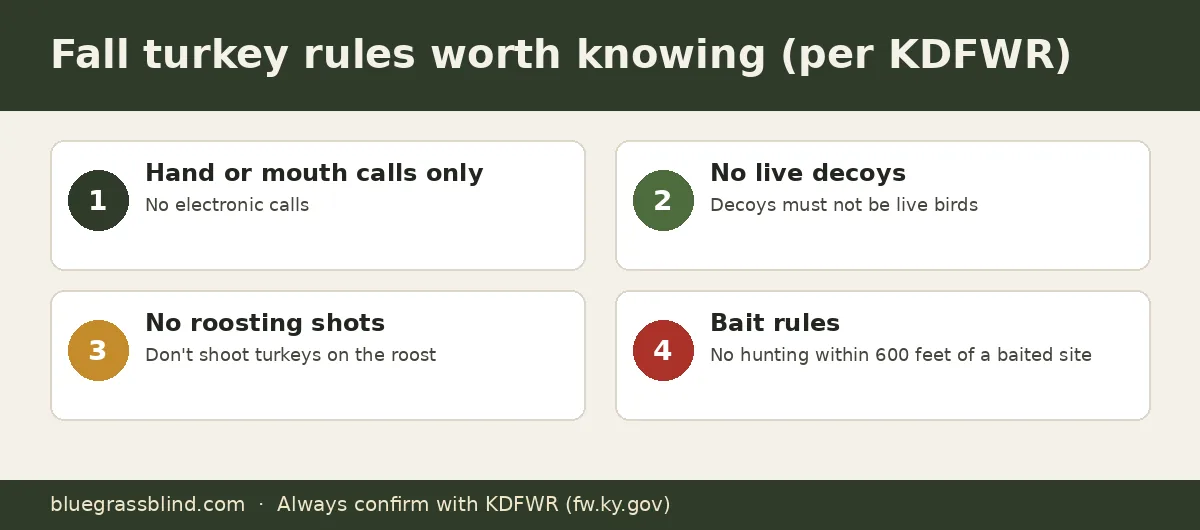
Other rules worth knowing from the guide: no shooting roosting turkeys, no live decoys, no electronic calls (hand- or mouth-operated calls only), and no hunting within 600 feet of a baited site or for 30 days after bait is removed. Some WMAs have special restrictions or are closed to fall turkey, so check the specific area.
Scouting flocks in fall
- Find the food. Acorns and other mast, harvested crop fields and grassy openings with bugs early in fall are worth checking.
- Look for sign. Scratched-up leaves, droppings, feathers and dusting spots.
- Glass from a distance. Watching fields from the road or a distance in the morning and evening can show you where flocks are traveling without bumping them.
- Get permission early. If you're asking a landowner, ask before season and respect their rules.
Basic gear: calls, blind, seat, camo
Generic categories only, no product picks yet:
- A beginner-friendly call. Box calls and slate (pot) calls are generally considered easier to learn than mouth calls.
- A ground blind is great with kids because it hides fidgeting. Brush it in with local vegetation. See Ground Blind vs Treestand.
- A comfortable seat, like a cushion or small chair, so you can sit still longer.
- Camo and a face mask or gloves. Turkeys have sharp eyesight and pick up movement fast.
- Hunter orange when firearm deer, bear or elk seasons overlap (more below).
- Binoculars, water, snacks and a headlamp.
Safety around calling and decoys
- Never stalk a turkey sound. It could be another hunter.
- Sit against a tree trunk wider than your shoulders so you're protected from behind.
- If you see another hunter, call out in a clear voice. Don't wave or make turkey sounds.
- Avoid red, white, blue and black clothing that can look like a turkey's head or body.
- Hunter orange: KDFWR says turkey hunters don't need it except in areas where deer, bear or elk are being hunted with a firearm. Kentucky's late fall shotgun turkey dates (Dec. 5–11, 2026) fall just before the late muzzleloader deer season (Dec. 12–20), and crossbow turkey overlaps modern gun deer season (Nov. 14–29). When in doubt, wear orange. See Hunter Orange Rules in Kentucky.
Telecheck and reporting basics
Turkeys are checked like deer. KDFWR's Recording, Checking, Tagging and Transporting page says:
- Fill out your harvest log as soon as you take the bird and before moving it: species, sex, date and county.
- Telecheck by calling 1-800-245-4263 or through the online check-in, by midnight on the day the bird is recovered and before processing.
- Write the confirmation number on your harvest log and keep the log with you while afield that season.
Bottom line
Fall turkey is a relaxed, family-friendly hunt. Scout food sources, sit still, follow the bag limits, and check in your bird the same day. Dates and rules change, so confirm everything in the current KDFWR turkey guide or call 1-800-858-1549 before you go.
Regulations change. Always check the current Kentucky Department of Fish & Wildlife Resources (KDFWR) hunting guide for seasons, limits and rules before you go.