Hunter Orange Rules in Kentucky
By J. B. Ellis, Kentucky

Hunter orange is one of the simplest safety rules in Kentucky, and also one of the easiest to get slightly wrong. Here's what KDFWR and the regulation itself say, in plain language, along with some practical tips for families heading out together.

What hunter orange is for
Hunter orange (sometimes called blaze orange) exists so other hunters can see you. Deer don't see color the way people do, which is why it can be required during gun seasons without ruining your hunt. During firearm seasons the woods get busier, and being visible from every direction is one of the simplest ways to prevent accidents.
When it's required in Kentucky
KDFWR's Hunting Regulations page says all hunters and persons accompanying them must wear hunter orange visible from all sides on the head, back and chest when hunting during daylight hours for any species during:
- the modern gun deer season,
- muzzleloader deer seasons,
- youth firearm deer seasons, and
- a firearm elk or bear season.
The regulation behind this is 301 KAR 2:172. For elk, the regulation applies the requirement within the elk restoration zone during an elk firearm season.
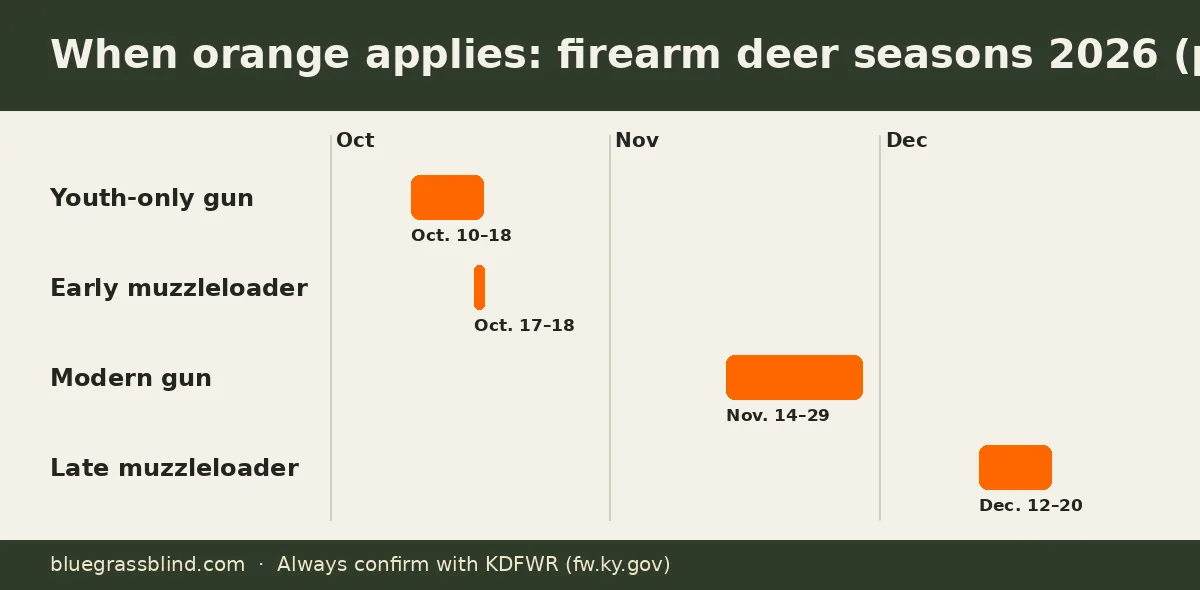
For 2026–27, KDFWR's Deer Hunting page lists these firearm deer seasons:
- Youth-only gun: Oct. 10–18, 2026
- Early muzzleloader: Oct. 17–18, 2026
- Modern gun: Nov. 14–29, 2026
- Late muzzleloader: Dec. 12–20, 2026
Some counties also have a CWD antlerless season (Sept. 25–28, 2026 in CWD Surveillance Zone counties, per KDFWR) where firearms are allowed. Check the current guide for whether orange applies in your area at that time. And the Free Youth Weekend (Dec. 26–27, 2026) is a firearm opportunity too, so plan on orange. Bear and elk firearm seasons have their own dates. Those dates change every year, so please confirm the current ones on fw.ky.gov.
Who it applies to (it's broader than you might think)
The phrase "any species" matters. KDFWR lists these as common violations:
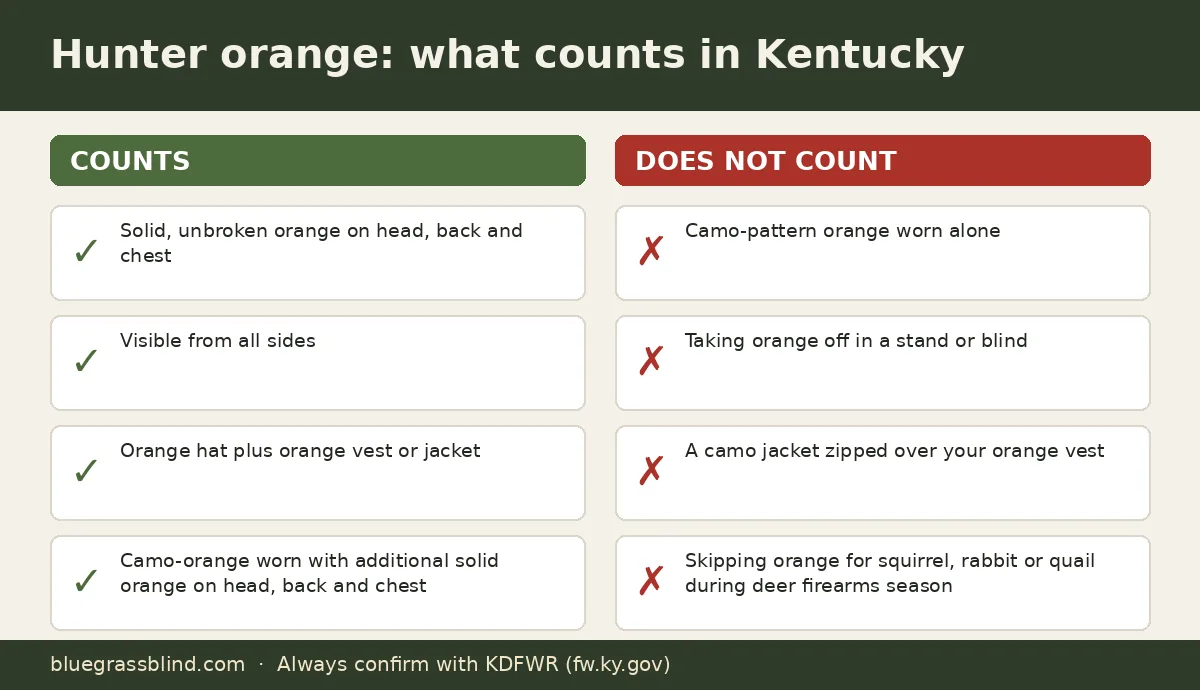
- Wearing camouflage-pattern orange without additional solid orange on the head, back and chest.
- Taking off your orange while on a stand or in a blind.
- Not wearing orange while hunting squirrel, rabbit or quail during deer firearms season.
KDFWR also says hunters using archery and crossbow equipment during deer firearms seasons must wear orange. The deer guide notes an exception for state-owned or -managed WMAs where firearms hunting for those animals is prohibited. Look up your specific WMA.
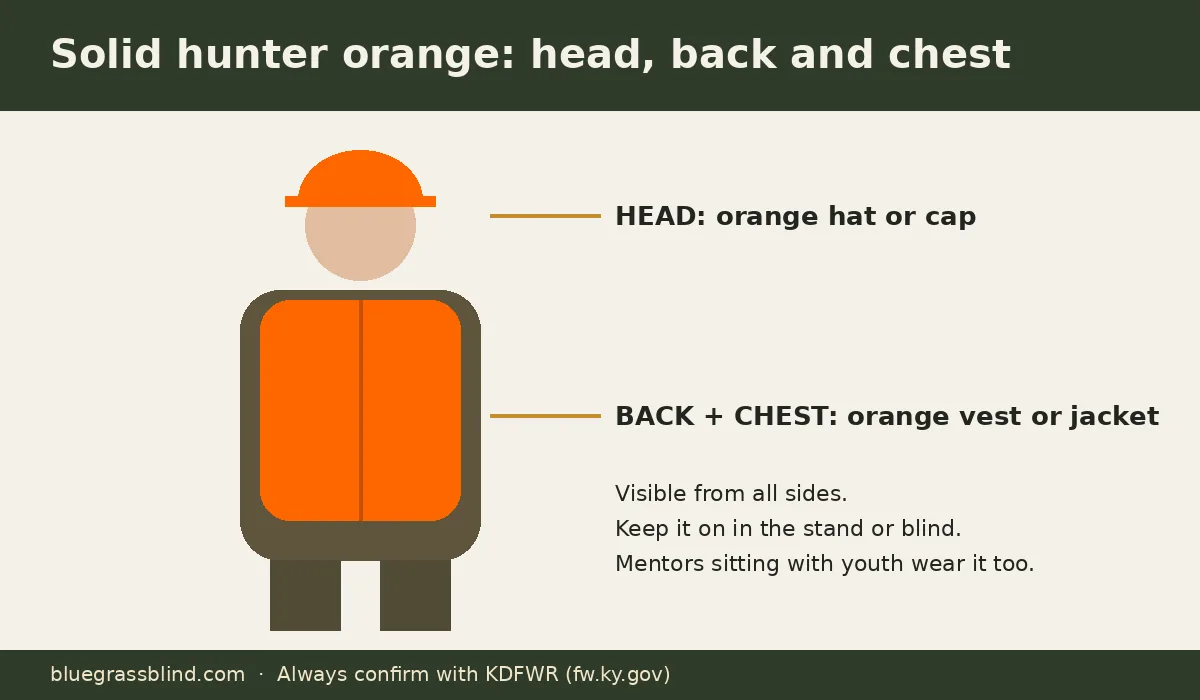
And it applies to the people with you. If you're sitting beside your son or daughter as their mentor, you need orange too, even if you're not carrying anything.
Exceptions
Per KDFWR, hunter orange is not required:
- when hunting waterfowl or doves during a gun deer, elk or bear season, or
- when hunting furbearers at night during a legal furbearer season.
Fall turkey hunters: KDFWR's turkey guide says orange isn't required for turkey hunters, except in areas where deer, bear or elk are being hunted with a firearm. In practice, that means if you're turkey hunting during a firearm deer season, wear it. See Fall Turkey Shotgun Season Basics.
What counts as a compliant garment
From 301 KAR 2:172 and KDFWR's summary:
- Solid, unbroken hunter orange, visible from all sides on the head, back and chest.
- It may display a small section of another color, like a small logo.
- Mesh is OK, as long as openings are no wider than 1/4 inch in any measurement.
- A camo-pattern orange garment worn alone does not meet the requirement. You'd need additional solid orange on the head, back and chest.
A simple way to think about it: an orange hat covers your head, and an orange vest or jacket covers your back and chest. Make sure your outer layers don't cover the orange. A camo jacket zipped over an orange vest defeats the purpose.
Orange in ground blinds and treestands
This catches people. Kentucky's rule doesn't have a blind exception. KDFWR specifically calls out taking off orange in a stand or blind as a violation. So keep it on the whole time you're hunting during those seasons, even when you're tucked inside a pop-up blind.
On public ground there's an extra rule. KDFWR's Hunting Regulations page says that whenever gun deer hunting is allowed on a wildlife management area, state park or Otter Creek Outdoor Recreation Area, anyone hunting from inside a ground blind must first attach a hat or vest of solid, unbroken hunter orange to the blind so it's visible from all sides. The clothing requirement still applies to everyone inside. On private land it's not listed as required, but it's a good habit anywhere.
In a treestand, the same goes. Wear your orange and your full-body safety harness.
Practical tips for families
- Fit matters for kids. An adult vest hanging off a 10-year-old can bunch up and leave the back uncovered. Look for youth sizes, or a vest that adjusts.
- Layer underneath, orange on top. In cold weather, put the orange vest on last so it stays visible.
- Bring a spare. Keep an extra orange hat in the truck in case one gets left at home.
- Check fading. Older orange garments can fade with sun and washing. If yours looks more pink or tan than bright orange, it's probably time to replace it.
- Make it a pre-hunt check. Before you walk in, look each other over: hat on, vest zipped over the coat, nothing covering the back. Kids remember rules better when they're part of a routine.
- Mentors count too. Supervising adults who aren't hunting don't need a license or deer permit, but KDFWR's deer guide says both the youth and the adult must wear hunter orange.
Hunter orange and hunter education
Hunter orange is one of the things the Kentucky hunter education course covers, along with firearm safety and hunting laws. If you have a young hunter, the course is the best place to start. Kids can take it at 9 and certification is required at 12 for anyone born on or after Jan. 1, 1975. I'd encourage parents to take it alongside their kids. You can find in-person classes and online-plus-Range-Day options on KDFWR's Hunter Education page. See also my beginner's guide to modern gun deer season.
What to look for in hunter orange gear
I'm not recommending specific products yet, but here's what I'd look for:
- Solid orange (not camo-only) for the required coverage
- A hat or beanie that stays on when you move
- A vest that's large enough to go over your warmest jacket
- Quiet fabric if you're bowhunting during gun season. Some cheaper vests are noisy.
- For mesh, check that openings are small enough to meet the 1/4-inch limit.
Bottom line
If any firearm deer, elk or bear season is open where you're hunting, wear solid orange on your head, back and chest, keep it on in the stand or blind, and make sure everyone with you does the same. Rules and dates can change, so confirm in the current KDFWR hunting guide or call 1-800-858-1549.
Regulations change. Always check the current Kentucky Department of Fish & Wildlife Resources (KDFWR) hunting guide for seasons, limits and rules before you go.