Kentucky Modern Gun Deer Season: A Beginner's Guide
By J. B. Ellis, Kentucky

If this is your first Kentucky gun season, or you're taking a youngster out for the first time, the rules can feel like a lot. This guide walks through what I've learned from reading the official Kentucky Department of Fish & Wildlife Resources (KDFWR) guides, plus the practical stuff that makes a first sit go smoother. I'm not a lawyer or a game warden, so please treat KDFWR as the final word on anything legal.
What the modern gun season is and who it suits
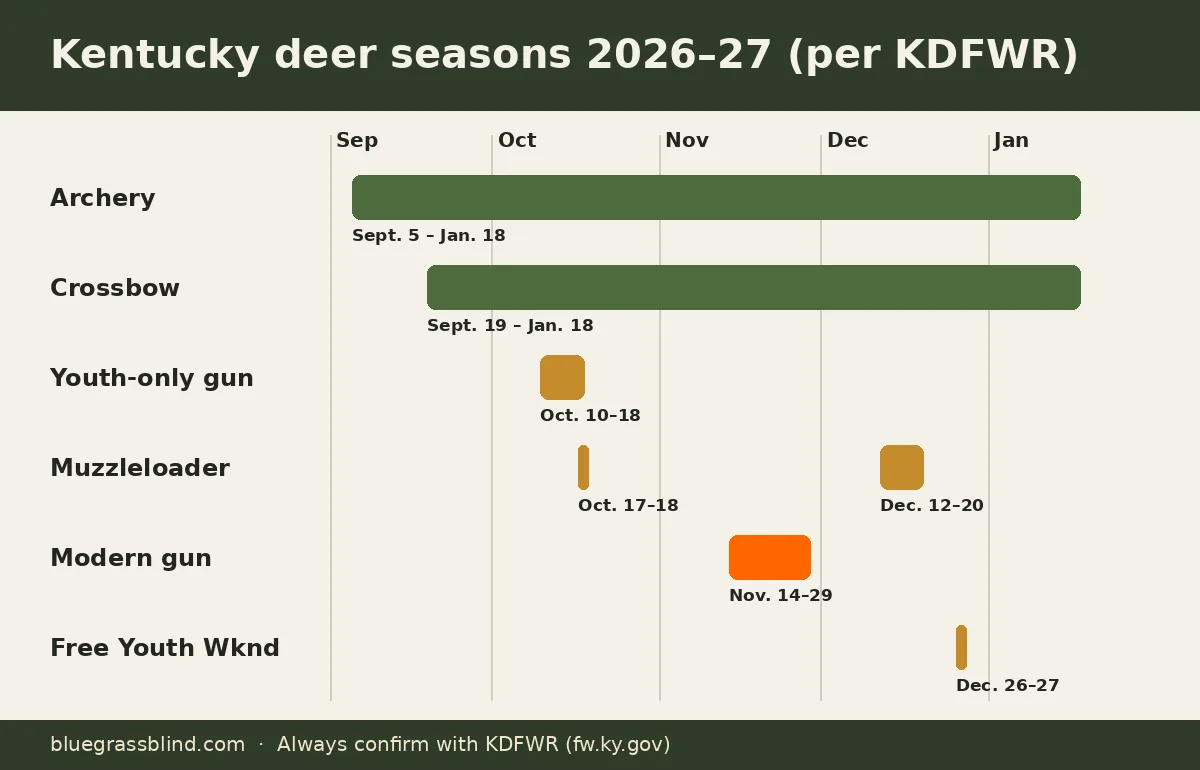
Kentucky splits deer hunting into several seasons by equipment: archery, crossbow, muzzleloader, a youth-only gun season, and the modern gun season. Modern gun is the shortest and busiest stretch. By regulation (301 KAR 2:172) it opens statewide on the second Saturday in November and runs 16 consecutive days. For the 2026–27 season, KDFWR lists the dates as Nov. 14–29, 2026.
KDFWR's deer page notes that during modern gun season you can also use muzzleloaders, archery and crossbow equipment, along with certain large-bore air guns, as long as you follow zone rules and the other requirements. I don't review or recommend firearms here, so if you're choosing equipment, start with a hunter education instructor or an experienced mentor.
Gun season suits beginners for a simple reason: shots are often at longer range than with a bow, which can make a first harvest more realistic. It's also when the most people are in the woods, so safety habits matter more than ever.
Where to find this year's official dates and zone rules
Dates move a little each year because they're tied to calendar weekends. Here's the 2026–27 picture as KDFWR lists it on its Deer Hunting page:
- Archery: Sept. 5, 2026 – Jan. 18, 2027
- Crossbow: Sept. 19, 2026 – Jan. 18, 2027
- Youth-only gun: Oct. 10–18, 2026
- Muzzleloader: Oct. 17–18 and Dec. 12–20, 2026
- Modern gun: Nov. 14–29, 2026
- Free Youth Weekend: Dec. 26–27, 2026
Kentucky counties are also sorted into deer zones, and your county's zone affects bag limits for antlerless deer. Some counties are inside the Chronic Wasting Disease (CWD) Surveillance Zone, which has its own rules on baiting and, on certain dates, mandatory sampling. For example, KDFWR's CWD Surveillance Zone page says hunters who take a deer during the first three days of modern gun season (Nov. 14–16) in Henderson, McCreary, Pulaski and Wayne counties must visit a staffed check station. Check your county's zone in the current KDFWR deer hunting guide before you go. These details can change from year to year.
Licenses, permits and hunter education
According to KDFWR's "Which License or Permit Do I Need?" page, the basic setup for deer is:
- Ages 12–15: Youth Hunting License + Youth Deer Permit
- Ages 16–64: Annual Hunting License + Statewide Deer Permit
- 65 and older or disabled: Senior/Disabled Sportsman's License
Nonresidents buy nonresident versions. There are license exemptions (for example, some landowners and young children), so read the official page if you think one applies. I'm not listing prices because they change; KDFWR's licensing page has the current numbers.
Hunter education: the most important step for young hunters
If you're taking a kid hunting, this is the section I'd ask you to read twice. Gear and spots can come later. Hunter education is where a young hunter learns to handle a firearm or bow safely, and KDFWR calls it a key part of reducing hunting accidents and injuries, encouraging responsible, law-abiding hunting, and supporting conservation.
What Kentucky requires, by age
Per KDFWR's Hunter Education page and its Hunting Regulations page:
- Born on or after Jan. 1, 1975: you must complete a hunter education course before hunting in Kentucky (KRS 150.170) and carry your certification card while hunting, unless you're exempt.
- Age 9: the youngest a child can take the course, exam and live-fire exercise.
- Under 12: exempt from certification, but must hunt with an adult who meets the hunter education requirement and is in position to take immediate control of the bow or firearm at all times. One adult can't accompany more than two hunters under 12 at once.
- Age 12 and up: certification is required. KDFWR points out that starting at 9 gives a youth a three-year window to get certified, so there's no need to wait.
- Under 16 with a firearm: must always be accompanied by an adult in position to take immediate control of the firearm, per the deer guide.
Resident landowners and their families are exempt only on the land they own or live and work on. KDFWR still highly recommends the course for them.
The exemption permit is a one-time option, not a substitute
Kentucky offers a one-time, one-year temporary hunter education exemption permit for people new to hunting. KDFWR lists it as free for a limited time. The holder must hunt with a licensed adult (18+) who meets the hunter education requirement and stays in position to take immediate control of the bow or firearm, even if the holder is an adult. It's available only once per person, is valid only in Kentucky, and when it expires you must complete the course. Think of it as a way to try hunting, not a way around the course.
How to sign up
KDFWR offers two routes, and pre-registration is required:
- In-person course: classroom instruction, a written test and a live-fire exercise. You're fully certified when the day is done. KDFWR says materials, including firearms and ammunition, are provided at no charge.
- Online course + Range Day: do the knowledge portion online with an approved Kentucky provider at your own pace, then pre-register for and attend an in-person live-fire Range Day to finish certification.
Use "Find a Course Near You" on the Hunter Education page, or call 1-800-858-1549. KDFWR says it offers more than 400 courses statewide each year. Kentucky also accepts hunter education cards from other states.
Parents: take it with your kids
If you were born before 1975 or already certified, you may not need the course, but sitting through it next to your son or daughter is one of the best things you can do. You'll learn the same rules they do, you'll be able to reinforce safe habits in the field, and it shows them you take it seriously. If you've never been certified, it's a natural thing to do together.
Also note: KDFWR says hunters under 16 hunting deer with a firearm must be accompanied by an adult in position to take immediate control of the youth's firearm at all times. Supervising adults don't need a license or deer permit if they aren't hunting, but both the youth and the adult must wear hunter orange.
Hunter orange and safety basics
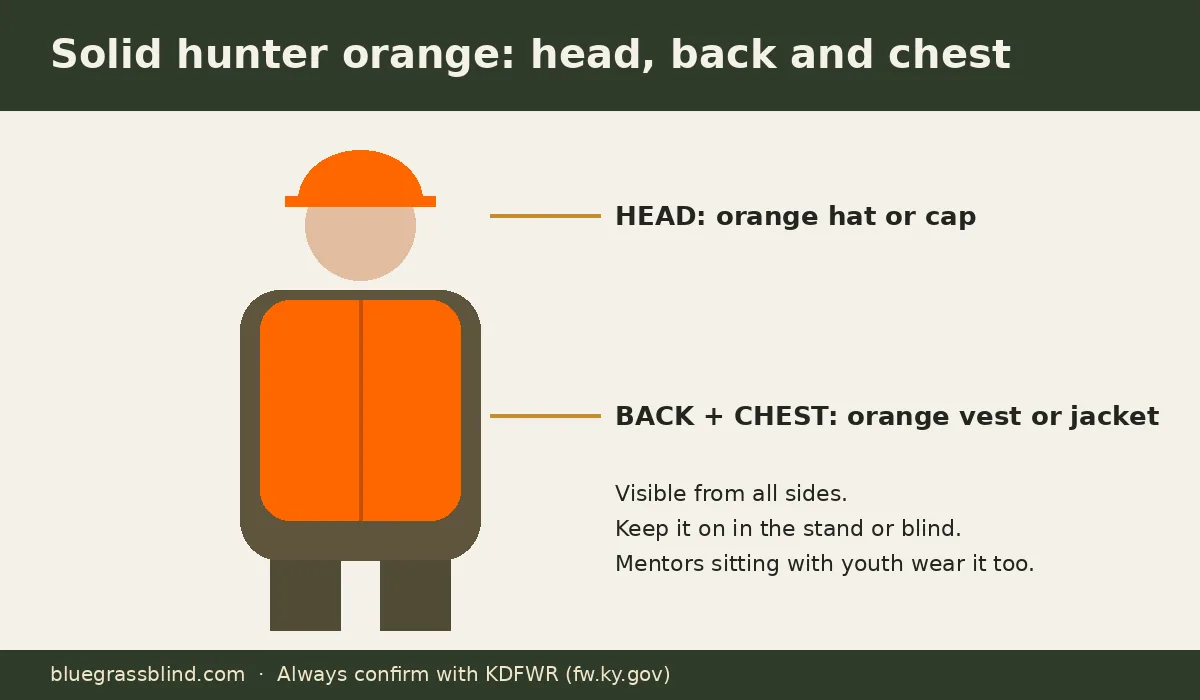
During modern gun season, KDFWR requires hunters and anyone accompanying them to wear solid, unbroken hunter orange visible from all sides on the head, back and chest. That includes bowhunters. A camo-pattern orange garment alone doesn't count, and taking your orange off once you're in a stand or blind is a listed violation. I cover the details in Hunter Orange Rules in Kentucky.
A few safety habits hunter education stresses, and that I try to live by:
- Treat every firearm as if it's loaded, and keep the muzzle pointed in a safe direction.
- Be sure of your target and what's beyond it before you ever shoot.
- If you're climbing into a treestand, wear a full-body safety harness from the moment you leave the ground.
- Tell someone where you'll be and when you'll be back.

A simple gear checklist for a first sit
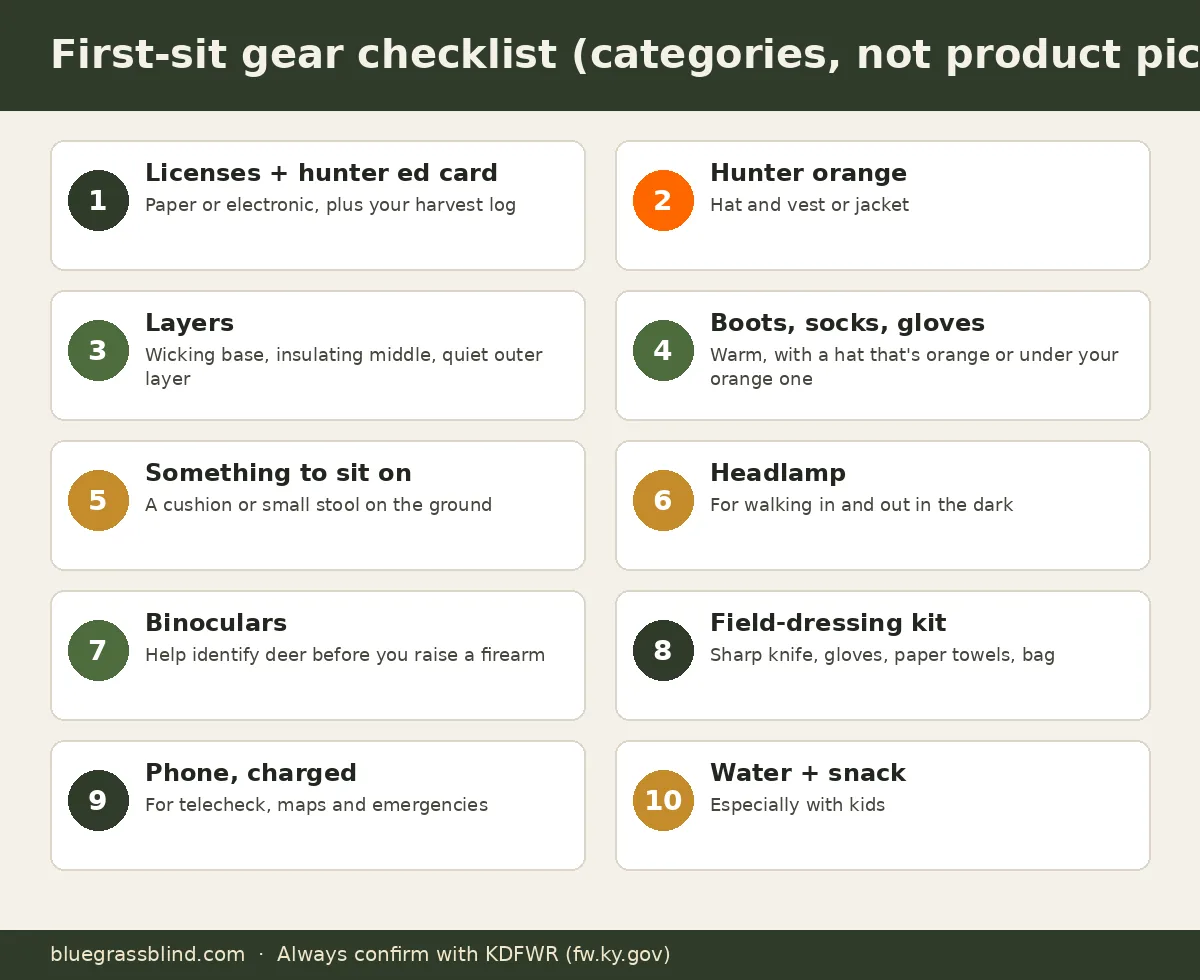
You don't need a truckload of gear. This is a generic list of categories, not product picks:
- Licenses, permits and hunter ed card (paper or electronic), plus your harvest log
- Hunter orange hat and vest or jacket
- Layers: a base layer that wicks sweat, an insulating middle layer, and a quiet outer layer. Mid-November in Kentucky can swing from mild to freezing, so check the forecast.
- Warm boots and socks, plus gloves and a hat that's orange or sits under your orange one
- Something to sit on: a cushion or small stool if you're on the ground
- Headlamp or flashlight for walking in and out in the dark
- Binoculars if you have them, which help with identifying deer before you raise a firearm
- Field-dressing kit: a sharp knife, gloves, paper towels, and a bag for your harvest log
- Phone, charged, for telecheck, maps and emergencies
- Water and a snack, especially with kids


Scouting and picking a spot
If you have permission on private land, walk it before season. Look for trails, rubs, scrapes, droppings and where deer are feeding. Acorns are a big draw in many Kentucky woods in the fall. Field edges and the inside corners of fields often see movement at dawn and dusk.
For public land, KDFWR's Wildlife Management Areas (WMAs) are open to hunting, but each WMA can have its own rules on seasons, equipment and quotas. Look up the specific area in the current hunting guide or on fw.ky.gov before you go. Also, KDFWR notes baiting is still banned on WMAs and public lands.
When picking a spot to sit, think about wind direction (deer have a great nose), a safe shooting lane with a good backstop, and an easy route in that won't spook deer.
After the shot: tracking, field care and checking your deer
Stay calm and take note of exactly where the deer was standing and which way it ran. Many experienced hunters wait before following a blood trail so they don't push a wounded deer. A mentor is a huge help here.
Once you recover your deer, KDFWR's Recording, Checking, Tagging and Transporting page lays out the steps:
- Fill out your harvest log right away and before moving the carcass: species, sex, date and county. License-exempt hunters and kids under 12 can write their own log on paper or an index card.
- Telecheck by calling 1-800-245-4263 or using the online check-in through your My Profile account at fw.ky.gov. It must be done by midnight on the day the deer is recovered and before processing. Write the confirmation number on your harvest log.
- Telecheck before removing the hide or head. If you must quarter the deer first, keep proof of sex with the carcass as the guide describes.
- KDFWR says a carcass tag is required if the deer leaves your possession for any reason, for example when dropping it at a processor.
Then field dress promptly and get the meat cool, especially on warm November afternoons.
Bottom line
Get your hunter ed (and take it with your kids if you can), buy the right license and permit, wear your orange, and know the telecheck steps before you go. Season dates and zone rules change, so double-check everything on fw.ky.gov or call KDFWR's info center at 1-800-858-1549. Good luck out there, and take a kid with you if you can.
Regulations change. Always check the current Kentucky Department of Fish & Wildlife Resources (KDFWR) hunting guide for seasons, limits and rules before you go.