Kentucky Spring Turkey Season: A Beginner's Guide
By J. B. Ellis, Kentucky

A first spring turkey hunt can be as simple as listening from a legal spot with an experienced mentor, learning what a real bird sounds like and making careful decisions together. You do not need a vest full of calls or an elaborate decoy spread to start. You do need permission, preparation and a willingness to leave a bird alone when the situation is not safe.
For Kentucky families, spring also offers a chance to build on hunter education without making a harvest the only goal. This guide covers the rules to check and the practical habits I would put ahead of buying more gear. It is researched guidance, not a claim that I have personally tested every approach or accessory.
What is confirmed about spring 2027 dates?
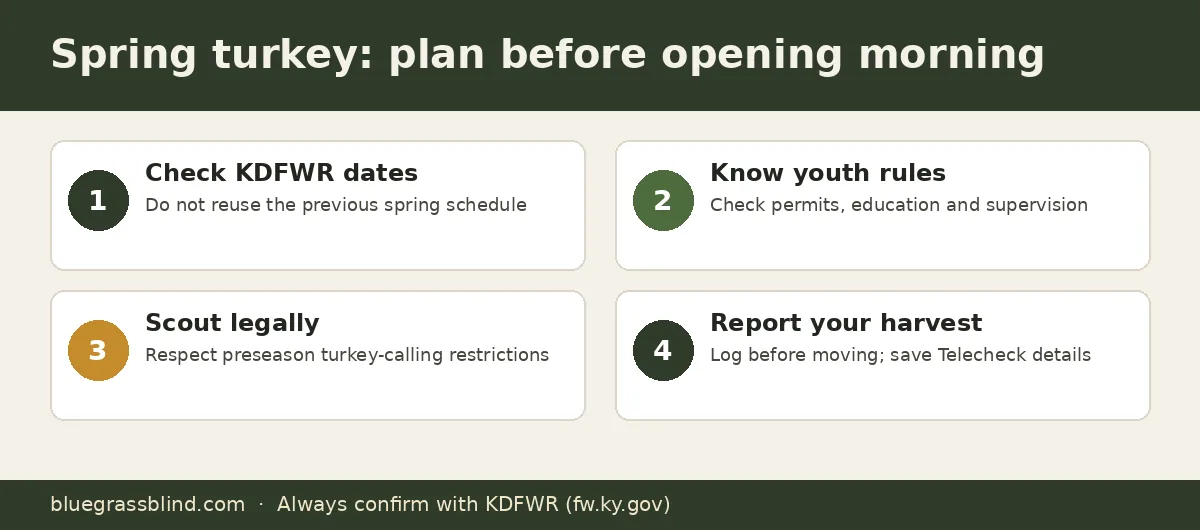
Checked November 6, 2026: The official KDFWR Spring Turkey Hunting page currently displays April 4–5, 2026, for youth-only hunting and April 18–May 10, 2026, for the general season. Those dates are past, not a spring 2027 schedule.
The same page describes the general season as twenty-three consecutive days beginning on the Saturday closest to April 15, and the youth-only season as two consecutive days beginning on April's first Saturday. However, I could not verify an explicitly published 2027 date table there. This guide therefore does not calculate or advertise 2027 opening dates. Dates are confirmed for each season; check KDFWR's current annual schedule before arranging time off or a family trip.
KDFWR currently lists shooting hours as thirty minutes before sunrise through thirty minutes after sunset. Hunters may be in the field outside shooting hours, but that does not allow an early or late shot. Use the correct local sunrise and sunset information and check the area's rules. Federal military reservations can have different dates and regulations.
Understand licenses before choosing a hunt
Unless exempt, spring turkey hunters sixteen and older must carry proof of a valid Kentucky hunting license and spring turkey permit. Short-term one-day and seven-day hunting licenses are not valid for turkey hunting. Check that your license package includes the needed privileges rather than assuming anything called a sportsman's license works for every hunter and circumstance.
Children fifteen and younger may participate in the youth-only weekend and general spring season. People sixteen and older may not hunt turkeys during the youth-only season. Under-twelve hunters are exempt from hunting license and turkey permit requirements, but not from harvest reporting or other hunting rules.
Unless exempt, youths twelve through fifteen need the required hunting license and turkey permit. KDFWR describes the Youth Turkey Permit as valid for one turkey during a license year; that is not permission to exceed a season limit. Check the exact permit combination your child needs before purchasing. Youths hunting turkeys with a firearm must have an adult positioned to take immediate control at all times.
Hunter education is a separate consideration from buying a license. Start with our Kentucky hunter education guide for kids and the official requirements. An age exemption is not a reason to skip safety lessons or distant supervision. Plan the outing around the youngster's readiness, not simply eligibility.
Know the spring limits and legal bird
The current KDFWR spring page defines a legal turkey as a male bird or one with a visible beard. It lists no more than one turkey per day and two per spring season. Birds taken during youth-only season count toward that youth's spring limit; the general opener does not reset it.
KDFWR also states that during spring, hunters may harvest only one bearded turkey per wildlife management area. Read this restriction along with the particular WMA's rules; do not treat the statewide two-bird limit as permission to take two birds wherever you choose. Check again when the new season's guide is available.
Positive identification comes before any decision to shoot. A sound, movement in brush or a patch of color is not enough. If you cannot confidently identify a legal bird and a safe situation, let it walk. For beginners, having a patient mentor explain that decision is more valuable than rushing for an opportunity.
Scout quietly and respect Kentucky's calling restriction
Begin with maps, property boundaries and permission. Look for places where you can sit safely, see approaching people and leave without crossing someone else's setup. Observe tracks, scratching and droppings without assuming a bird will use the same route every morning. Listening and watching are useful even when you never make a turkey sound.
Kentucky specifically restricts preseason turkey calling. KDFWR prohibits mimicking turkey sounds in areas open to turkey hunting where turkeys are reasonably expected from March 1 until youth-only season opens, and between the close of youth-only season and the statewide opener. Do not practice yelps in those woods during the restricted periods.
The page permits locating with owl, crow, coyote or woodpecker calls while scouting. That exception is not permission to use turkey sounds. Practice a hand-operated call somewhere appropriate outside the restricted hunting situation, and ask KDFWR if your circumstances are unclear. Keep scouting considerate of landowners, wildlife and other hunters.
Bring a small, useful kit
Pack required documents, hunter education proof when applicable, a paper harvest log and pencil, a charged phone, offline map, headlamp, water, snacks and a small first-aid kit. Add weather-appropriate layers and rain protection. Spring mornings can feel different from the walk back, so choose layers you can remove without unloading the entire pack.
A comfortable seat helps a beginner remain still without turning the hunt into an endurance test. Camouflage can help conceal movement, but fit and comfort matter more than buying a particular pattern. Keep your face and hands concealed when appropriate, without blocking vision or hearing. Check children for cold hands, fatigue and uncomfortable seating.
One simple hand-operated call is enough to begin learning. An optional decoy adds carrying weight and safety decisions; it is not a requirement for a first hunt. Learn safe handling with qualified instruction and verify legal hunting equipment on the official spring page rather than treating a packing article as equipment authorization.
Calling and decoys: safety before realism
Never stalk a turkey sound. Another hunter may be calling. Never approach an unsafe situation. Choose a setup with a clear view and a substantial tree or other protective background behind you where practical. Know what lies beyond the bird, including trails, roads, houses and other hunters.
Decoys can attract a person's attention as well as a turkey's. Avoid approaching other hunters while carrying an exposed decoy or harvested bird. Keep decoys covered during transport and do not put one where another hunter's approach could put you in the line of fire. If someone approaches your setup, identify yourself with a clear voice rather than turkey sounds or sudden waving.
KDFWR does not require hunter orange during spring turkey seasons, but recommends wearing some while carrying a harvested turkey. Pack orange for that purpose and consider it while walking. Do not wear clothing that could be mistaken for a turkey's conspicuous colors. These precautions supplement, rather than replace, positive identification and safe handling by everyone present.
Check bait and prohibited methods
Do not assume a familiar deer-feeding location is legal for spring turkey. KDFWR prohibits hunting turkeys over bait and considers an area baited until thirty days after bait is removed. Its spring page also explains a March 1–July 31 wildlife-feeding restriction, with listed exceptions. Read those details instead of trying to judge legality from whether feed is visible today.
The spring rules prohibit electronic or digital calling devices, live decoys, harvesting a roosting turkey and using a dog during spring season. Other method restrictions also apply. Our fall turkey guide is useful for comparison, but fall and spring are not interchangeable rulebooks. Always return to the spring guide for this hunt.
Plan harvest reporting and the walk out
Carry a harvest log even for a license-exempt child. Fill it out as soon as the turkey is taken and before moving the carcass, recording species, sex, date and county. Telecheck is available by phone at 1-800-245-4263 or through KDFWR's online system. Save the official instructions before leaving home.
Check the turkey by midnight on the day it is recovered and before processing. Write the confirmation number on the harvest log and keep the completed log while afield during the season. If transferring possession, attach the required handmade carcass tag with the hunter's name, phone number and confirmation number. See KDFWR's reporting and tagging page for the complete process.
Arrange help with field care and prompt cooling before the hunt. For a child's first morning, leave room for a snack break and an early finish. Hearing a gobble, identifying tracks and making one good safety decision can be a worthwhile beginning. The aim is a young hunter who understands why the rules matter and feels welcome to learn again.
Official sources
KDFWR Spring Turkey Hunting; General Hunting Regulations; Recording, Checking, Tagging and Transporting. Future dates and area-specific rules require another check before hunting.
Regulations change. Always check the current Kentucky Department of Fish & Wildlife Resources (KDFWR) hunting guide for seasons, limits and rules before you go.