Kentucky Hunter Education for Kids: A Parent's Guide
By J. B. Ellis, Kentucky

Taking a child hunting starts well before opening morning. Before the camouflage, the snacks and the first deer sighting, there needs to be a foundation: understanding the rules, listening carefully and knowing that safety comes before getting an animal.
Hunter education helps build that foundation. For Kentucky families, it is also something worth planning early instead of trying to squeeze in just before a child's twelfth birthday. This guide explains the requirements and course choices, with practical suggestions for making the experience encouraging rather than overwhelming.
Rules checked November 6, 2026: This guide uses Kentucky Department of Fish & Wildlife Resources (KDFWR) sources, including the 2026–27 deer guide. Confirm current requirements, course instructions and hunting-area restrictions before making plans.
Why hunter education matters for kids
KDFWR's program covers more than passing a test. Subjects include safe equipment handling, hunting laws, wildlife identification, conservation, ethics, first aid and field care of game. Those lessons give parents and children a shared starting point for talking about responsible hunting.
I would treat the certificate as the beginning of learning, not proof that a child is ready to hunt independently. A youngster can understand a classroom lesson and still need patient reminders outdoors. Keep practicing the habits the instructors teach, and make it clear that asking a question or choosing not to take a shot is always welcome.
Taking the course before certification becomes legally necessary also leaves room to learn without a deadline hanging over the family. Readiness varies; the minimum course age is not a promise that every child will feel comfortable that year.
Kentucky's age rules: nine, twelve and the birth-date requirement
Kentucky generally requires hunters born on or after January 1, 1975, to carry proof of valid hunter education certification while hunting, unless an exemption applies or they have the temporary exemption permit. That birth-date rule applies to parents as well as young hunters.
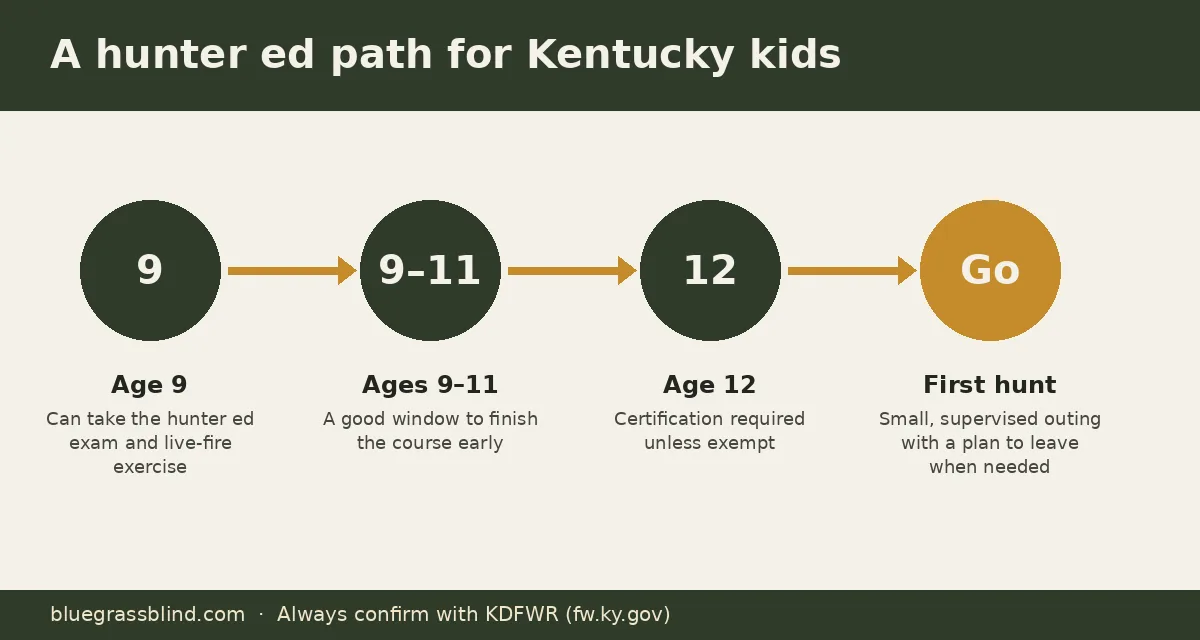
Children must be at least nine years old to take the hunter education exam and participate in live-fire exercises. Certification is required beginning at age twelve unless the hunter qualifies for an exemption. Ages nine through eleven therefore offer a useful window to complete the course before the requirement normally begins.
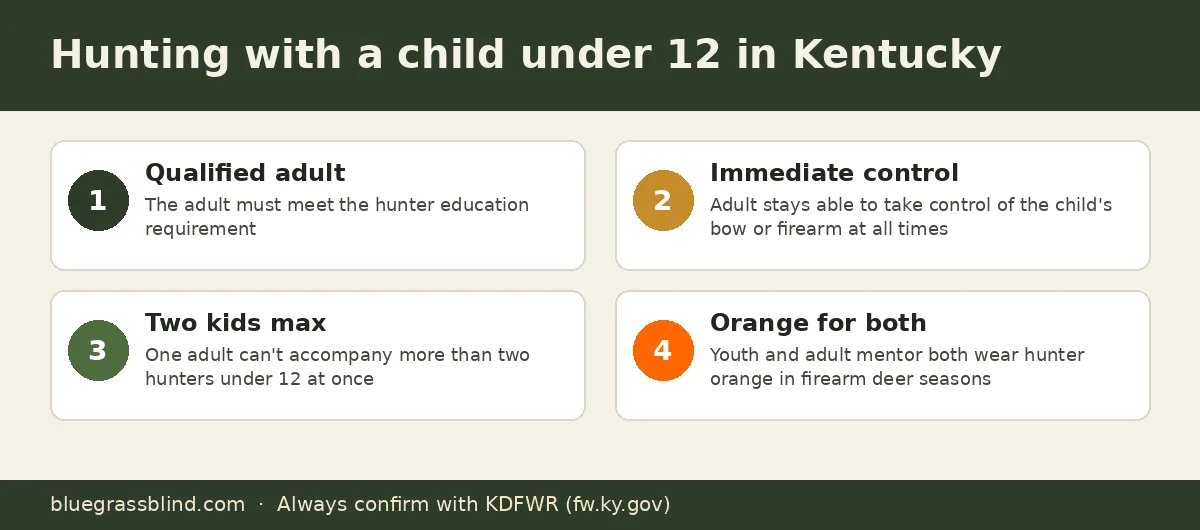
Children younger than twelve are exempt from hunter education certification, but they must hunt with an adult who meets the hunter education requirement. The adult must remain in a position to take immediate control of the child's bow or firearm at all times while hunting. One adult cannot accompany more than two hunters under twelve at the same time.
That means being together and able to intervene, not watching from a distant stand or waiting at the truck. Separately, Kentucky's deer rules require every hunter under sixteen hunting deer with a firearm to have an adult positioned to take immediate control. Earning a card at twelve does not remove that deer-hunting supervision rule.
Two ways to finish the course
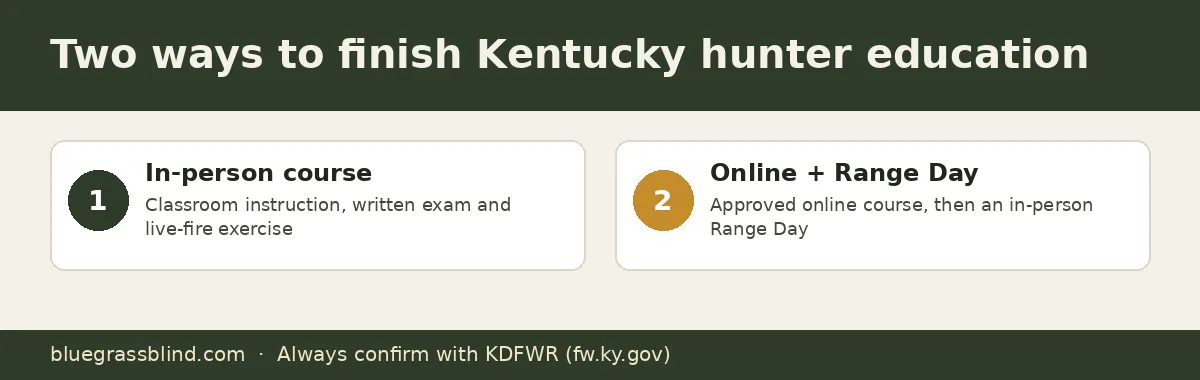
In-person course: KDFWR describes this as a complete certification option with classroom instruction, a written exam and a live-fire exercise. Its current page says successful students finish certification that day. Check the actual event schedule and instructions before registering. KDFWR says in-person course materials, including the equipment for the exercise, are provided at no charge.
Approved Kentucky online course plus Range Day: Students complete the knowledge portion through a provider listed on KDFWR's hunter education page, then pre-register for and attend an in-person live-fire exercise, called Range Day. Finishing the online lessons alone does not complete the usual youth certification process.
Online study may suit a family that needs shorter learning sessions, while an instructor-led class may suit a child who learns best by asking questions face to face. Neither option replaces adult involvement. Start with KDFWR's approved-provider list rather than assuming any course found through a search will qualify.
Pre-registration is required for all hunter education courses. If choosing online study, look at Range Day availability early too. Read each event's instructions for arrival, required documentation and anything students should bring; contact the listed coordinator when something is unclear.
How to sign up through KDFWR
Start at the official KDFWR Hunter Education page. For the classroom route, follow Course Registration. For the online route, use its approved Kentucky online course links and Range Day Registration. The Education Course Events calendar is the official place to look for available classes and Range Days.
Choose an event your family can actually attend, check the location and schedule carefully, and complete pre-registration for the student. Keep the registration confirmation and follow the event's directions. Do not assume a parent and child share one registration if both intend to earn certification; ask the organizer how each participant should register.
If the right class is not obvious, use the regional hunter training coordinator contacts on the education page. After certification, keep proof accessible for hunting. KDFWR's regulations explain that certification can be viewed or added through MyProfile, and its education page links to replacement-card printing.
Exemptions are limited, not shortcuts to safe hunting
Kentucky offers a one-time hunter education exemption permit valid for one year from its issue date. It lets a newcomer hunt before completing certification, but the holder must hunt with a licensed adult at least eighteen years old who meets the hunter education requirement and can take immediate control of the bow or firearm.
The permit is valid only in Kentucky and is not accepted at Blue Grass Army Depot or Fort Campbell. It does not replace required hunting licenses or species permits. When it expires, a hunter who remains subject to the education requirement must complete the course. Think of it as a supervised introduction, not a substitute for education or an annually renewable workaround.
There is also a landowner-related exemption. KDFWR lists resident landowners, their spouses and dependent children, and qualifying tenants and their families as hunter education exempt only on the property they own or where they reside and work, as applicable. It is not a blanket exemption for visiting another person's farm. Confirm the underlying license-exempt category in the official regulations; when hunting elsewhere, the normal education law applies. Even when exempt, taking the course is worthwhile.
Help your child arrive ready to learn
Before class, explain what the day involves and invite questions about anything that feels unfamiliar. Plan for sleep, food, weather-appropriate clothing and travel time. Follow the organizer's equipment instructions rather than bringing hunting equipment without checking first.
For online lessons, use manageable sessions and let your child do the learning. Ask them to explain a rule in their own words instead of supplying answers. If they are tired or frustrated, pause. The goal is understanding that carries into the woods, not racing through screens.
Consider taking the course together, even if you already qualify for an exemption. Ask about attending or registering alongside your child. Hearing the same instruction gives you common language for later practice, and a parent willing to learn sends a better message than one who acts as though safety lessons are only for children.

After the card: plan a small, supervised first hunt
Start with a scouting walk and an honest conversation about comfort, attention and following directions. For the first hunt, favor a manageable outing with a clear plan to leave when your child needs a break. A quiet morning learning wildlife signs can still be a good day; a harvest does not have to be the measure of success.
For 2026–27, the KDFWR deer guide lists the youth-only modern firearms season as October 10–18, 2026. That season has already passed as of this article's check date. Do not reuse those dates for a later year. The guide lists Free Youth Weekend as December 26–27, 2026.
During that December deer weekend, resident and nonresident youths under sixteen accompanied by an adult may hunt deer statewide without a hunting license or deer permit. Bag limits and other deer requirements still apply. “Free” does not mean unsupervised or unrestricted: check hunter education requirements and exemptions, land access, local area rules and harvest reporting separately.
For the rest of your planning, read our Kentucky beginner's deer guide, hunter orange rules and fall turkey basics. Each species and season needs its own rules check. Start with education, keep supervision close and let the child's confidence grow at the child's pace.
Official sources
KDFWR Hunter Education; KDFWR Hunting Regulations; 2026–27 Deer Hunting Guide (season table and Youth Deer Hunting section); KDFWR Education Course Events. Course openings and future-season dates can change; check the official pages before registering or hunting.
Regulations change. Always check the current Kentucky Department of Fish & Wildlife Resources (KDFWR) hunting guide for seasons, limits and rules before you go.