What to Pack for Your First Kentucky Deer Hunt
By J. B. Ellis, Kentucky

A first deer hunt does not require a truck full of expensive gear. It does require a little preparation: clothing that keeps you comfortable, the right paperwork, a way to find your way home and a plan for caring for a deer if the hunt goes well. For a young hunter, add an adult who is willing to slow down and call it a day when needed.
This is a practical packing list, not a list of products I claim to have tested. Borrow suitable equipment when you can, check its condition and practice using it before opening morning. Put safety and a manageable first outing ahead of camouflage patterns or accessories.
Rules checked November 6, 2026: Kentucky Department of Fish & Wildlife Resources (KDFWR) rules are the starting point. Check the current deer guide, your county's deer zone and the particular property's restrictions before hunting. This checklist does not replace hunter education or the official regulations.
Start with paperwork, permission and a harvest log
For hunters sixteen and older, Kentucky generally requires an annual hunting license and deer permit unless exempt. Youth requirements differ by age and circumstances; do not assume an adult's license covers a child. Carry acceptable proof of your own license and permit, and hunter education certification when required. The official deer guide explains proof options, youth rules, exemptions and zone limits.
Keep a paper backup in a zip bag even if you use electronic proof. Download documents before leaving home rather than depending on reception. Pack a pencil or working pen and a harvest log. License-exempt hunters and children under twelve still need a harvest log; KDFWR allows them to make one on paper or an index card.
Get permission before entering private land, including to retrieve a deer. Save the landowner's contact information and mark boundaries on an offline map. On public land, read that area's current rules rather than assuming statewide seasons cover every opportunity. Our Kentucky beginner's deer guide explains the broader planning questions.
Dress in layers, not one heavy outfit
Think in three parts: a moisture-managing base layer, insulation for sitting still and an outer layer that handles the forecast. The walk to a spot and a quiet sit feel very different. Carrying an insulating layer in your pack can be more comfortable than wearing everything on a steep walk and arriving sweaty.
Wool or synthetic base layers are useful options. Choose clothing you can move in without binding, and try the whole outfit at home while sitting, kneeling and wearing your pack. A quiet, comfortable jacket already in your closet may be a better starting point than a new hunting coat that does not fit.
Pack rain protection when the forecast calls for it, along with an insulating hat and gloves. For kids, bring a spare warm layer and agree that shivering or wet clothes means speaking up immediately. Set a weather limit before leaving; no clothing system makes every forecast suitable for a beginner.
Pack hunter orange where it stays visible
KDFWR requires hunters and accompanying people to wear hunter orange outer garments visible from all sides on the head, back and chest during daylight hunting in the specified firearm deer seasons. This includes archery hunters hunting during those seasons. A solid orange cap and vest are a straightforward combination; camouflage-pattern orange alone does not meet the requirement.
Wear orange over your outer clothing, not under a coat. Keep it on in a stand or blind, and check that a backpack is not covering the required visibility. Adults accompanying children need orange too. Our Kentucky hunter orange guide covers the details, including the additional blind-display rule when gun deer hunting is allowed on certain public properties.
Give boots, socks and a seat real attention
Wear boots you have already walked in. Choose traction, fit and weather protection for the ground you will actually cross. Tight boots and crowded socks are a poor bargain even if the boots are heavily insulated. Pack dry spare socks in a waterproof bag, especially for children who may find every puddle on the walk.
A small seat cushion or stable ground chair can make a short sit easier. Test it in daylight and consider whether a child can sit comfortably without sliding or needing constant adjustment. Keep extra gloves accessible. Hand warmers are optional comfort items; follow their instructions and do not use them as a reason to ignore cold or numb hands.
If you use a tree stand, pack a complete safety system
A tree stand is not required for a first hunt. A suitable ground setup may simplify a family outing. If you do use an elevated stand, a properly fitted full-body fall-arrest harness and a compatible connection system belong ahead of comfort accessories. Stay connected while climbing, transferring and sitting, following the stand and harness manufacturers' instructions.
Inspect straps, attachment points, hardware and the tree before use. Respect weight limits that include clothing and gear. Practice at ground level with an experienced mentor, and understand the manufacturer's rescue and suspension-relief instructions before climbing. A harness in the pack does nothing while you are disconnected.
Use an appropriate haul line for equipment rather than climbing with occupied hands. Follow hunter education guidance for safe equipment handling and never improvise a child's harness fit. Tell someone exactly where you will be and when to expect you back. If the setup or your confidence is doubtful, stay on the ground.
Carry light, navigation and a small emergency kit
Pack a headlamp with fresh batteries and a backup light. Use lighting for safe walking, not searching fields for deer. Carry a charged phone, an offline map and a small power bank if needed. Learn your route in daylight, note gates and creek crossings, and carry a compass you know how to use rather than relying entirely on a phone.
A compact first-aid kit, whistle and emergency layer or blanket are sensible additions. Include personal medications and tell your hunting partner about relevant needs. Leave your location and return plan with someone who is not hunting. Water and easy snacks matter too; put a child's snack within reach instead of at the bottom of a noisy pack.
Keep the knife and field-dressing kit simple
A manageable, sharp knife in a secure sheath or protected closed position is more useful than several unfamiliar tools. Add disposable gloves, paper towels, a bag for waste and a way to clean your hands. A small light reserved for close work helps if recovery runs late. Keep blades away from children and never reach into a pack for an exposed knife.
Before hunting, arrange help from someone who knows field dressing and safe meat handling. This packing guide is not a cutting tutorial. Plan how you will move a deer, where you can cool it promptly and which processor you will use if needed. Check processor hours and acceptance requirements beforehand. Ask for help rather than attempting an unsafe solo drag on steep ground.
Review current KDFWR chronic wasting disease information for your hunting county, including sampling and carcass-movement requirements. These can affect your recovery and transport plan. Keep supplies for any required sample separate and follow official instructions rather than guessing what a processor will handle for you.
Save Telecheck details before the hunt
KDFWR requires the harvest log to be completed as soon as the animal is taken and before moving the carcass. Record species, sex, date and county. Report the deer through Telecheck by midnight on the day it is recovered and before processing; deer must be checked before removing the hide or head. Save 1-800-245-4263 and the official online reporting page ahead of time.
Write the confirmation number on your harvest log and retain the completed log while afield during the current season. If transferring possession, including dropping the deer at a processor, attach a handmade carcass tag with your name, phone number and Telecheck confirmation number. The harvest log and transfer tag serve different purposes. Read KDFWR's recording, checking, tagging and transporting instructions before leaving home.
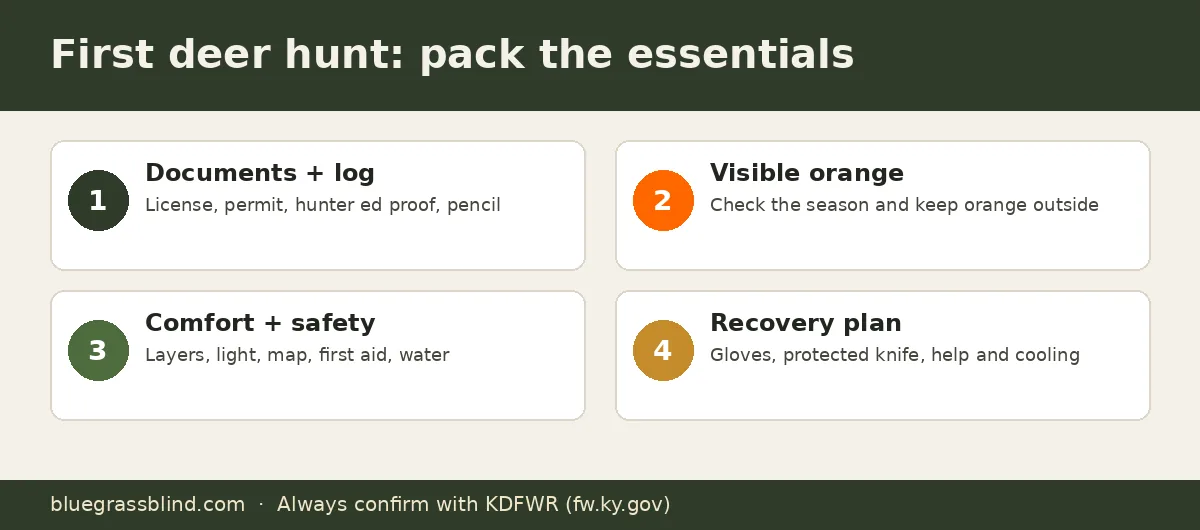
A final pack check with your young hunter
Lay everything out together: documents, log and pencil; orange; layers and dry socks; light, map and charged phone; first aid, water and snacks; knife and gloves; and a recovery plan. Add the complete safety system only if a suitable stand is part of the plan. Review our hunter education guide for Kentucky families before choosing the outing.
Let the child explain where important items are and how to ask for a break. Keep their load light and the first hunt short enough to finish well. Coming home safely, understanding a little more about the woods and wanting to go again are worthwhile outcomes, with or without a deer.
Official sources
KDFWR 2026–27 Deer Hunting Guide; General Hunting Regulations; Recording, Checking, Tagging and Transporting. Gear suggestions are general preparation advice, not legal requirements unless identified as such.
Regulations change. Always check the current Kentucky Department of Fish & Wildlife Resources (KDFWR) hunting guide for seasons, limits and rules before you go.